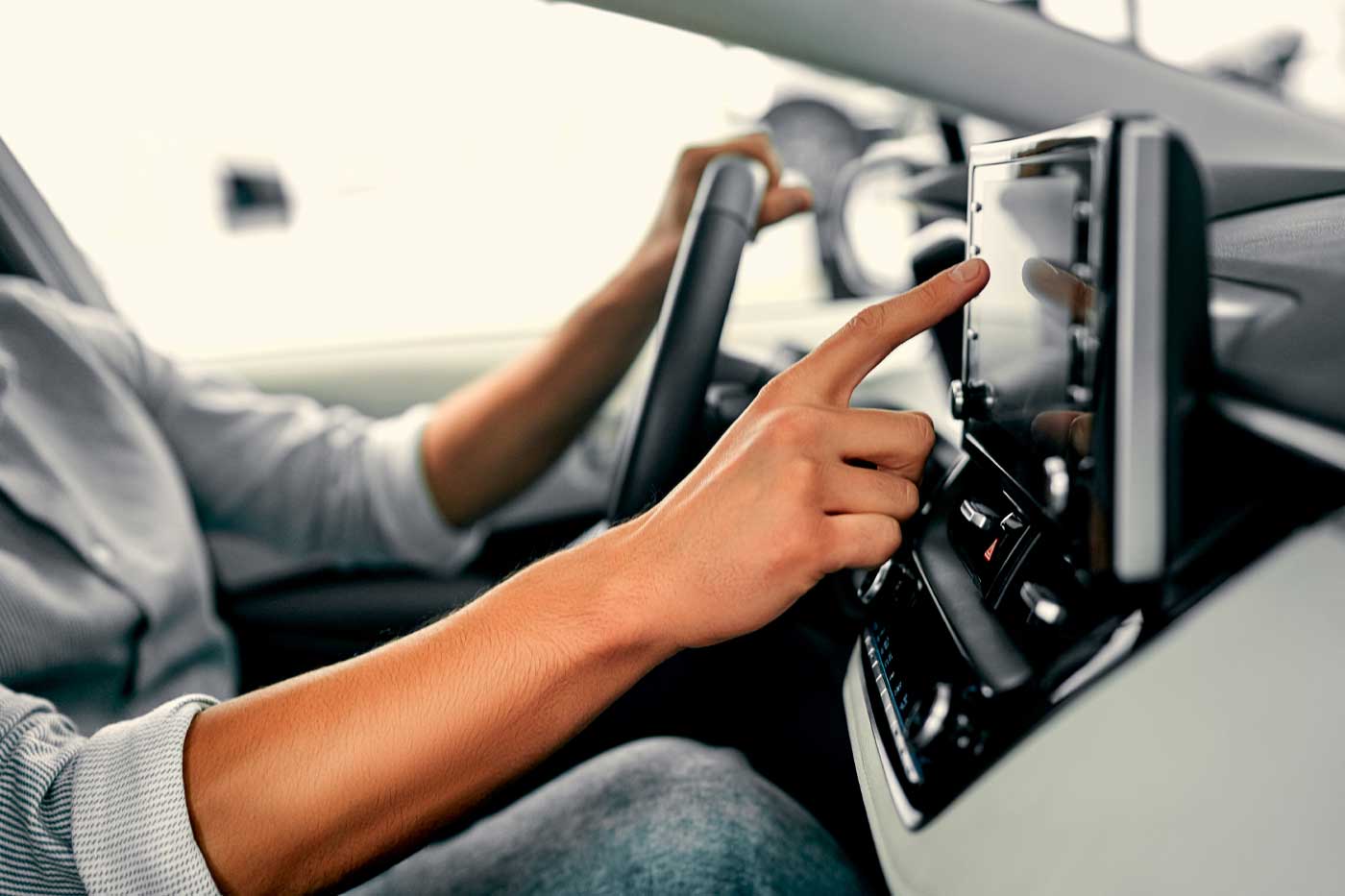
WILLIAMSBURG—Safety officials and policymakers have taken action to combat distracted driving by banning the use of handheld digital devices behind the wheel. But as in-vehicle touchscreen controls are increasingly incorporated into modern car designs, transportation researchers are examining the distraction potential presented by these sleek interfaces.
Gabrial Anderson, Virginia Tech Transportation Institute research associate in the division of Vehicle, Driver and System Safety, presented analysis of the popular design trend at the 12th annual DRIVE SMART Virginia Distracted Driving Summit in Williamsburg in August. Virginia Farm Bureau Mutual Insurance Co. is a conference sponsor.
The analog buttons and dials in older vehicles allow drivers to instinctively control the radio or temperature with minimal distraction. However, Anderson said a recent review showed that 97% of new cars globally have some type of in-vehicle touchscreen element, with many replacing familiar tactile controls.
“With a touch-based system, it’s all smooth glass with markers for tapping,” he explained. “If I want to change the temperature, now I have nothing to reach for. I just have a smooth glass to interact with, which means I have to take my eyes off the road.”
These screens are not only becoming more prevalent, they also are increasing in size, he said.
“Drivers are noticing this design trend, and they’re not necessarily happy with it. Cell phone use while driving is dangerous, so putting a giant screen on the vehicle dash is kind of contradictory.”
Anderson contributed to VTTI studies that found center-stack touchscreen consoles can create visual tension between the motorist and roadway ahead.
For analog center stacks, adjusting tactile in-vehicle controls took about 1½ seconds of motorist attention. Adjusting fully digital center-stack touchscreen controls took roughly 5½ seconds of attention.
“Glances over 2 seconds in duration away from the forward roadway have been shown to increase crash risk,” Anderson said. “Digital center stack interactions were more likely to have these sustained glances. You might as well just be closing your eyes for 2 seconds when you do that!”
Vehicle manufacturers are hearing consumer feedback, innovating hybrid systems and marketing their physical controls. Some new vehicles feature a tablet and digital instrument cluster, with physical controls linking to the touchscreen.
For example, it may take one screen tap to display temperature settings, with a physical wheel to adjust it.
“This is one way that you could have a hybrid design that’s more modern and innovative,” Anderson said. “But also retains some level of safety.”
Media: Contact Anderson at 540-231-1549 or Rich Jacobs, DRIVE SMART Virginia, at 804-929-2988.