RICHMOND—As farmers work long, laborious hours this fall harvest season, motorists are encouraged to do their part to protect the people providing for their communities.
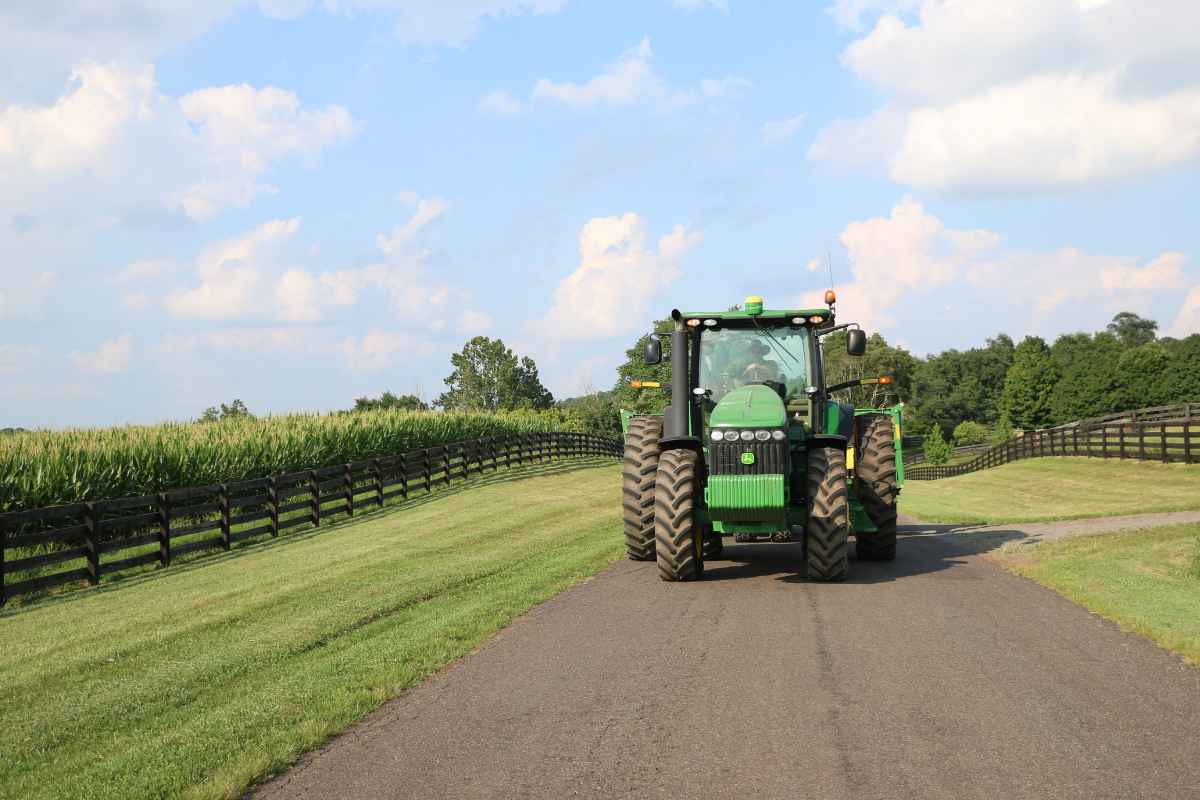
From now until the end of November, various activities will require farmers to drive large, slow-moving machinery on public roadways to complete their harvests. As they work against weather, crop conditions and narrow harvest windows, motorists should expect to encounter farm equipment even at the riskiest times—like near dusk, after dark or during peak traffic hours.
And sharing the road with tractors, combines and other large farm machinery is inherently risky, cautioned Matt Nuckols, Virginia Farm Bureau safety coordinator.
“Farm equipment and passenger vehicles are very different in their size, shape and how they’re designed to protect the operator,” he noted. “When they collide, the consequences can be serious for everyone involved.”
According to the National Safety Council, approximately 15,000 farm vehicles are involved in highway crashes annually. Studies of collisions between slow-moving vehicles and motor vehicles show that about two thirds of those are rear-end collisions.
A car traveling 55 mph takes 5 seconds to brake 300 feet—the length of a football field—to avoid colliding with farm equipment moving up to 20 mph.
State law requires equipment that travels 25 mph or slower to be marked with a triangular slow-moving vehicle emblem when operated on public roads. Many farmers also use flashing amber lights, reflective decals and escort vehicles to alert approaching motorists.
“The simplest thing a driver can do is slow down immediately, create space and wait until it is clearly safe and legal to pass,” Nuckols advised.
In general, motorists should slow down and stay alert whenever approaching blind corners and hills on rural roads, as speeding drivers may not see a large combine or tractor until it’s too late.
Additionally, drivers should avoid risky behavior when attempting to pass farm equipment, which is often wider than a single travel lane and restricts operators from seeing drivers who are following too closely.
Before passing farm machinery, drivers must adhere to the laws of the road; ensure that the road is wide enough for both vehicles; make sure there are no roadside obstacles or oncoming vehicles; and check for turn lights or hand signals from machinery operators. If the machinery slows and pulls toward one side of the road, the operator may be preparing to make a wide turn.
When in doubt, don’t risk it.
“If necessary, follow them for a little while,” Nuckols encouraged. “That piece of equipment isn’t just something slowing down traffic. There’s a farmer in that seat trying to safely get from one field to the next.”
He added that “a few extra minutes is a small price to pay to make sure everybody gets home safely.”
Visit vafb.com/Safety for more information on rural road safety.
Media: Contact Nuckols at 804-938-2043.