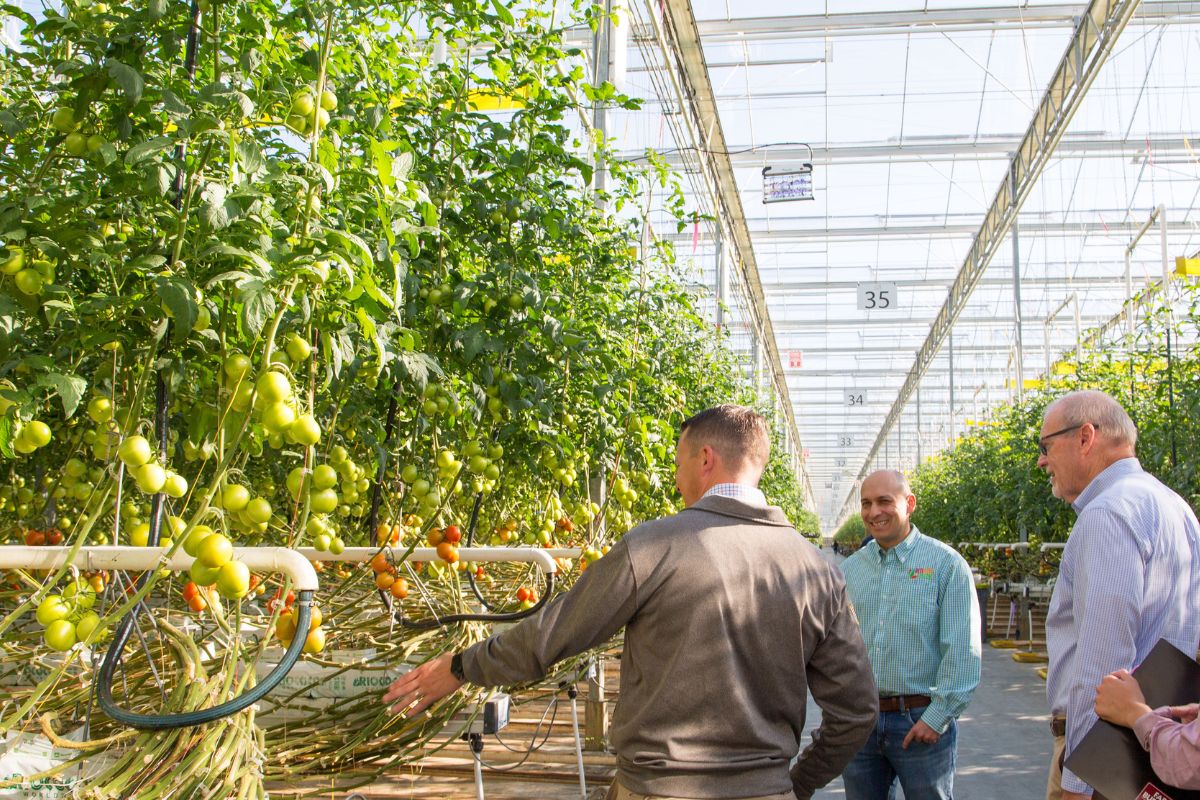
RINER—Virginia farmers voiced their opinions on critical agricultural issues to U.S. Rep. Morgan Griffith, R-9th, during October roundtables held in Montgomery and Tazewell counties. The discussions were accompanied by farm tours of area greenhouse, beef cattle, dairy and pumpkin operations.
Virginia Farm Bureau members and industry representatives emphasized the need for a five-year farm bill, expanding local food access and addressing widespread development pressure on agricultural land. Participants also discussed challenges with fuel regulations, dairy marketing, cattle markets, the efficacy and availability of small ruminant medications, and labor access.
The Oct. 8 discussion was hosted by VFBF President Scott Sink at his family’s Riner Ridge Farm, which includes produce fields, a scenic event venue and farm market. VFBF board member Emily Edmondson hosted the Oct. 13 discussion at her family’s beef cattle farm in Tazewell.
Roundtable participants discussed the need to build on the farm bill’s Supplemental Nutrition Assistance Program successes, including expanding statewide food nutrition education and fostering farm-to-school partnerships.
“What can we do to help facilitate food access across the commonwealth?” queried Mike Gutter, director of Virginia Cooperative Extension, during the Oct. 8 roundtable.
Griffith expressed interest in exploring methods of redirecting local produce surpluses to food assistance programs.
He said disagreements over SNAP provisions are driving farm bill delays.
“The bottom line is, I’m not going to stop a farm bill unless it does something outrageous,” he noted.
Farmers also noted regulatory ambiguity in President Donald Trump’s Oct. 5 executive order to temporarily allow the use of red-dyed diesel on public highways and waive the federal excise tax through Dec. 31. They questioned whether on-road vehicles found with traces of red-dyed diesel on Jan. 1 would be subject to hefty fines, as dyed diesel remnants linger in fuel tanks, and the order doesn’t mention a grace period on inspections.
“If you see something like this, don’t hesitate to call our D.C. office,” Griffith urged producers. “It doesn’t mean I can fix it, but I can at least check on it and maybe get you an answer.”
The Internal Revenue Service stated on Oct. 14 that it will not impose a penalty when dyed diesel fuel is sold for use or used on highways nationwide. The relief is retroactive to Oct. 1 and will last through the end of the calendar year, and no federal inspections of on-road dyed fuel usage will occur during this time. The IRS hasn’t waived the requirement to pay diesel fuel taxes, but said it will explore ways to waive the need to pay any tax amounts deferred.
Producers considering using dyed diesel in on-road vehicles are still advised to use caution, plan on having to pay these federal back taxes for nonexempt uses, and check whether using dyed diesel in on-road vehicles will negatively impact their vehicle warranties.
Additionally, Gov. Abigail Spanberger issued Executive Directive 5 on Oct. 16 authorizing the temporary use of dyed diesel fuel in on-road vehicles. The governor’s action directs the Department of Motor Vehicles to use its authority to waive penalties for the use of dyed diesel on roadways and help Virginians take advantage of the new directive.
Additionally, cattle farmers discussed how rising transportation costs have exacerbated the impacts of recent closures of JBS’ Souderton and Tyson Foods’ Joslin beef processing plants.
“When Tyson announced they were closing the Illinois plant, JBS gutted their East Coast cattle-buying team, which has led to a lack of competition for a lot of cattle that originate in Virginia,” noted Brandon Reeves, executive director of the Virginia Cattlemen’s Association.
Reeves emphasized the need for more regional independent processing facilities and market transparency.
Griffith thanked roundtable participants for their valuable insights and encouraged producers to “keep bringing us your ideas.”
Other farmers raised concerns about rising operational costs and critical labor challenges. Ernesto Sanabria of Red Sun Farms discussed the Dublin greenhouse’s reliance on H-2A labor to produce around 300,000 pounds of tomatoes weekly for grocery store distribution centers.
“We’ve basically gone through the entire labor force here, so to have the availability of the working team from Mexico is a lifeline,” he noted, adding that processing delays “put everything in jeopardy.”
Virginia Farm Bureau presented Griffith with a letter signed by county Farm Bureau presidents and other industry groups requesting his support of H.R. 9535. Introduced by U.S. Rep. Glenn “GT” Thompson, R-Pa., the bipartisan bill aims to provide agricultural producers with wage stability and flexibility and improve processes for seasonal workers within the H-2A agricultural visa program.
Griffith also toured Jeff Reeves’ beef cattle and hay operation in Pulaski County, the Sowers family’s Floyd County dairy and beef farm, and Edmondson’s pumpkin patch and corn maze in Tazewell.
Media: Contact Olivia Gyapong, VFBF national affairs specialist, at 240-483-1932.